When More Range Doesn't Help: Capacity and Composition
Flexibility expands options. Composition determines meaning. The distinction between physical capacity and aesthetic skill in adult movement training.

This article explores compositional and aesthetic considerations in flexibility training from a movement instructor’s perspective. The frameworks presented are observational tools, not prescriptions. It is not medical advice, diagnostic information, or a substitute for working with qualified professionals. Bodies, training histories, and goals vary widely. Consult appropriate healthcare providers and certified instructors for assessment and programming specific to your needs.
Flexibility is often the doorway. We start because we want a shape: the split, the backbend, the high extension, the line we've seen repeatedly framed as the mark of "advanced." In adult training spaces, it's common to assume that if range improves, movement will automatically look and feel more skilled. Yet something crucial gets missed in that equation.
What We’re Actually Seeing
Many of the movers we admire trained for years in systems where how a body occupies space is taught with the same seriousness as what the body can do: dance, rhythmic gymnastics, martial arts, and related lineages. What we’re seeing isn’t usually the result of a 200-hour teacher training program—it’s years of professional-level, often multi-disciplinary training. The expertise is invaluable, but there’s often a gap between what enabled someone’s development and what they explicitly teach.
That gap is where adult learners get confused. We’re practising in interdisciplinary environments where pole studios borrow from ballet and gymnastics, vinyasa yoga classes often use contortion and contemporary dance phrasing, and online education labels much that makes movement look skilled as “flexibility.” In these spaces, it’s easy to mistake an instructor’s crossover personal style—often built on decades of formal training—for the system being taught, or to assume that increasing range alone will deliver the aesthetic that we’re admiring.
The Distinction
This post argues for a cleaner distinction: Flexibility is a physical capacity. Artistry is a set of discipline-specific skills and aesthetic choices. Capacity expands options; composition determines choices. Some practitioners train flexibility for its own sake—functional capacity, injury prevention, or simply the satisfaction of increased range. This article focuses specifically on the compositional and aesthetic dimensions for those interested in that layer.
Capacity Does Not Equal Craft
A useful analogy is language. Increasing vocabulary gives us more words. It does not automatically make us better writers.
Flexibility functions similarly. Increasing range gives us more possible positions and pathways, but it doesn’t necessarily teach us what to emphasize, what to quiet, how to organize attention, or how to arrange the body in space so that movement reads as intentional. Flexibility training expands our physical options. Artistry training teaches us how to use them.
This may be why it’s possible to become significantly more flexible and still feel that movement looks “unfinished.” For many practitioners, the missing ingredient isn’t more depth—it’s more organization.
Alignment vs. Artistry
Most adult classes teach alignment: skeletal stacking, load management, and baseline organization that keeps bodies safer. Alignment matters. But alignment and artistry are distinct layers, even when they overlap.
An aligned base can read differently depending on needs and preferences. For example, overhead arm positioning in ballet reflects specific stylistic choices, while pole work emphasizes pulling mechanics and gymnastics requires pressing power. All three organize the shoulder girdle differently according to their functional and aesthetic priorities.
Without exposure to multiple disciplines, these organizational options may never be explored. They simply reflect different needs and preferences.
The Missing Piece
This is what adult learners often don't get taught explicitly. We're told what shape to hit, sometimes how to protect joints, but not how to compose the shape—how to refine it for expressive qualities, how shapes relate to each other, or how to navigate the transitions between them within an aesthetic tradition. Without compositional education, students may attempt to solve an expressive problem with a capacity solution: more stretching, more drills, more intensity.
For many practitioners, that’s the “pushing harder doesn’t help” experience: effort increases, frustration increases, results stay flat—because the lever being pulled isn’t the one that governs the outcome. (I explored this dynamic in “Frazzled? When Skills Won’t Come and Pushing Harder Doesn’t Help.”)


The Interdisciplinary Landscape
Adult movement education is richly interdisciplinary. We can study pole with dancers, learn mobility from a capoeira mestre, take flexibility with circus artists, and borrow concepts across worlds that used to be inaccessible. This cross-pollination has opened movement education to far more people—a profound cultural gain.
It also creates conceptual ambiguity. Aesthetic education that was once embedded in long-term conservatory training now lives in a different context, where students assemble their own curriculum from multiple sources.
Why Adult Training Environments Blur Style and System
In conservatories, students enter a clearly defined aesthetic tradition consciously. In adult interdisciplinary spaces, aesthetic systems become implicit—present but unstated, shaped by each teacher’s background rather than explicit curriculum.
A teacher’s training quietly shapes what’s emphasized. Students may attribute cues to the system being taught—vinyasa yoga, pole, flexibility training—when they’re actually coming from the instructor’s personal history. A yoga teacher with ballet training may cue rotation and line in ways that aren’t standard yoga pedagogy. A pole instructor trained in gymnastics may emphasize calisthenics and acrobatics.
This is how beautiful hybrid styles emerge. Without understanding the source, though, we can chase flexibility hoping it will deliver style, or assume compositional choices are universal when they’re discipline-specific.
Video demonstrating ballet, jazz, and contemporary dance influences on a vinyasa yoga sequence, as well as a technical foundation rooted in hand balancing and contortion.
Why Range Gets Credit for Composition
When we see movement that reads as compelling, we're responding to organization, not just range.
Training lineage matters. Russian ballet emphasizes long lines and dramatic épaulement; American ballet prioritizes speed and musicality. A martial artist, pole athlete, and contemporary dancer might execute the same split depth, but training shows up in rotation placement, weight distribution, and visual emphasis. Who taught us, where we trained, what was prioritized—all leave traces in how we organize movement.
Consider something as simple as pointing the foot. A coherent line from shin through ankle to toes requires conditioning and control. Once that exists, styles emerge: the ballet "winged" foot, Cabaret bevel, pole sickle, jazz forced arch. The variation is stylistic; the capacity to produce it is technical.
What Actually Creates Readable Movement
Photos emphasizing extreme ranges mislead. The real information lives in transitions: how a limb travels through space, whether line quality holds as load changes, whether stillness or tension is deliberate.
What creates this? Rotation training. Line awareness. Weight management through transitions. Upper body carriage. Articulation. Performance quality. Compositional intelligence. These are trainable but distinct from flexibility work itself.
Compelling movement doesn’t require extreme range. A 45-degree attitude derrière can read as skilled as deeper range if rotation is clear and the upper body coordinates—creating full-body composition. A simple tendu can become art with dedicated practice. The same principle appears in Sun Salutations: the difference between an unhurried sequence that flows with awareness and one that merely hits shapes has less to do with depth than integration.
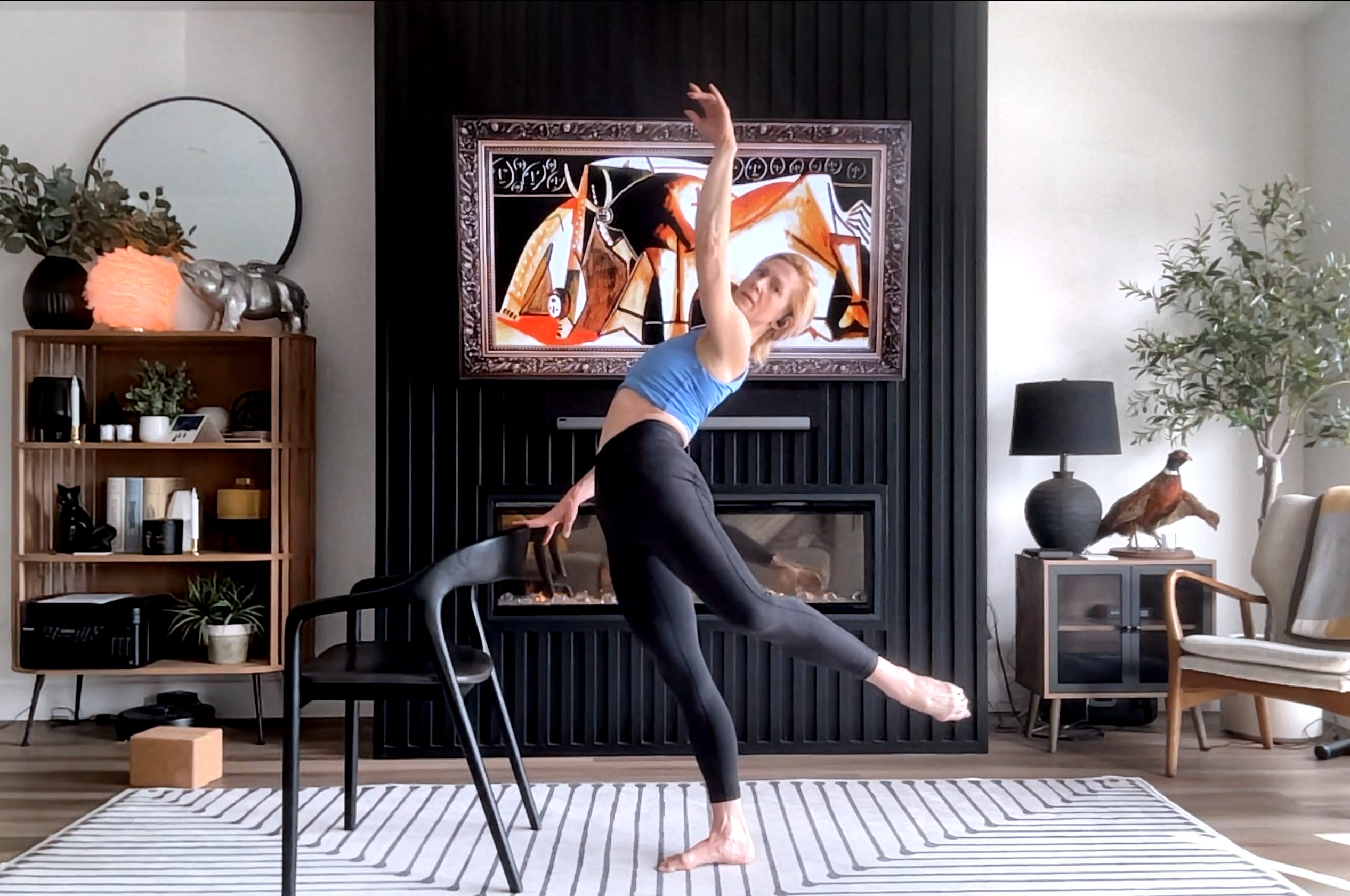
Screenshot from Bronwen's Framework class: transition through low attitude in a wave exercise.
Developing a Discerning Eye
This kind of discernment is optional—it serves practitioners interested in aesthetic dimensions of movement, not a requirement for meaningful flexibility practice.
Start With Awareness
For those interested in building not just capacity but awareness, watch the same movement executed across different training backgrounds. A standing split performed by a ballet dancer, rhythmic gymnast, and gymnast reveals discipline-specific choices: Where is rotation emphasized? How is weight distributed? How are the arms used? What does the supporting leg do? These aren’t random variations—they’re compositional priorities.
Seek Clear Representatives
Watch people trained deeply in one tradition: ballet companies, circus performers, rhythmic gymnasts, martial artists. Watching people trained in different disciplines helps us see how principles apply across aesthetic traditions. The distinctions become clearer when we're not parsing multiple influences within a single mover.
Questions to Ask
When we hear a cue or concept: Where does this influence come from? Is this structural integrity or stylistic choice? What tradition does this belong to? Strong teachers name their influences and clarify multiple valid approaches. When we see these distinctions, we stop chasing flexibility as an aesthetic solution.
Allow Time
Developing this eye takes immersion. It’s like learning to look at paintings—at first we see “art,” then gradually technique, composition, art historical references. Ask teachers about their training. Watch performances, not just clips. Engage with the traditions we’re drawn to. The more we observe across contexts, the clearer the patterns become.
What This Means for Training
The influencers we’re watching often have decades of experience in ballet, dance, contortion, or gymnastics—disciplines where compositional precision is inseparable from practice itself. Many have transitioned from professional careers to teaching flexibility, yoga, pilates, or pole. While these classes build foundational capacity, they may not explicitly teach the compositional qualities the instructor embodies.
This isn’t criticism—these instructors have opened movement education to adults in profound ways, and their expertise is invaluable. Understanding the gap between what shaped an instructor’s aesthetic and what’s being taught explicitly simply helps us train more strategically.
These observations about aesthetic development are separate from questions of injury prevention, rehabilitation, or medical assessment—topics that require consultation with appropriate healthcare professionals.
Extreme flexibility isn't required to move well, nor does increasing range alone teach compositional organization. Flexibility expands options. Composition determines meaning.
When that distinction is clear, our training becomes more intentional. We can pursue the aesthetic dimensions that genuinely interest us while honouring flexibility as what it is: a supportive capacity that expands what's possible without dictating how it's expressed.
Further Reading
On Dance Alignment and Aesthetics:
Dance Alignment: Perfect Posture? - FitPro
The “Right Way” to View Art: Who Gets to Decide? - Serenade Magazine
Ballet Style Comparisons:
Ballet Styles Compared Part 1: The Russian School - The Dance Lens
Ballet Styles Compared Part 3: NYC Ballet and The Balanchine Style - The Dance Lens
Related: