Seoul
Eating. Walking. Training. Maintenance as travel philosophy.

If I could have stayed longer, I would have. I spent a week in Seoul at the beginning of February, staying in the Myeongdong district. My stay featured my brand of tourism: finding food, stumbling upon landmarks and navigating specifically to others, eating, and taking class. Of course South Korea is known for K-Pop, karaoke, and nightlife, but, in the interests of time and energy (jet lag was real), I largely invested my efforts in more daytime pursuits. Training brought me to fitness and dance spaces, but I also managed to slip in visits to ancient sites, contemporary galleries, futuristic shopping complexes, pop-up shops, coffee houses, more sock stores than I’ve ever seen or fathomed a need for, outdoor markets, and food halls that rival Harrods and Galleries Lafayette. I became well acquainted with the subway and, while I don’t track my steps, the state of my feet will tell me that I walked… a lot.
The Health Place
Luckily, I didn’t have to go far to find a gym. The fitness centre as an annex to the hotel became part of my routine, a space also open to locals who seemed to know of it as one of the city’s best. A woman I had met at a sushi boat bar in the Lotte food hall wasn’t exaggerating. The facility spanned three floors from the 13th to the 15th, with one level dedicated to a pool, another to a gender-segregated sauna, steam room, hot and cold whirlpools, echoing Korea’s broader bathhouse culture, and another to a well-equipped gym, mobility area, and two golf simulator rooms.
In Korean, gyms are commonly referred to as heolseu-jang, literally “health place,” a linguistic detail that carries a slightly different connotation. In this particular space, the emphasis felt closer to maintenance and longevity than spectacle, even if the broader aesthetics culture certainly exists here as well.
I trained there during office hours and found myself alongside adults more seasoned than I, moving steadily through their routines. The centre handed out uniforms with locker service, eliminating decisions about what to wear or how to commute with a bag in tow. You simply showed up and trained.
A large TV screen looped gentle yoga flows in the corner, but I never saw anyone watching it. Phones and video-taking were strictly prohibited. People were there to train, not scroll through playlists or record influencer footage, which was a minor inconvenience for this someone who, while not much of an influencer, had every intention of recording something. One person in particular caught my attention with her active flexibility work, moving from half-frog into centre split, rotating the hip from internal to external rotation and oscillating through the full range, with a few nerve glides layered in. It was very much how I would approach it. On another day, a woman worked with her trainer, both laughing softly as they moved through what looked like a meticulous examination of foot placement. The focus in the room was palpable, but there was ease as well. People were there to work, but they weren’t grim about it.
Class in Korean
Each time I visit a city, I generally do a deep dive ahead of time into local studios—yoga (Ashtanga or more in trend Vinyasa or Power), dance, hand balancing—to see where I feel most aligned or, in many cases, geographically reasonably close to. The Ashtanga shala was a 40-minute commute away, so that was out. I did, however, find Seoul Tanz Station, which had daily morning ballet classes scheduled, a strong socials presence (which I also look for in today’s market), and was located about 20 minutes away. I found my way to the Sinchon district for 10:30 am classes. Chatting with the receptionist, I learned that she used to live in Vancouver and train at Harbour. We likely missed each other there by about a decade, but it does show how small the dance world actually is.
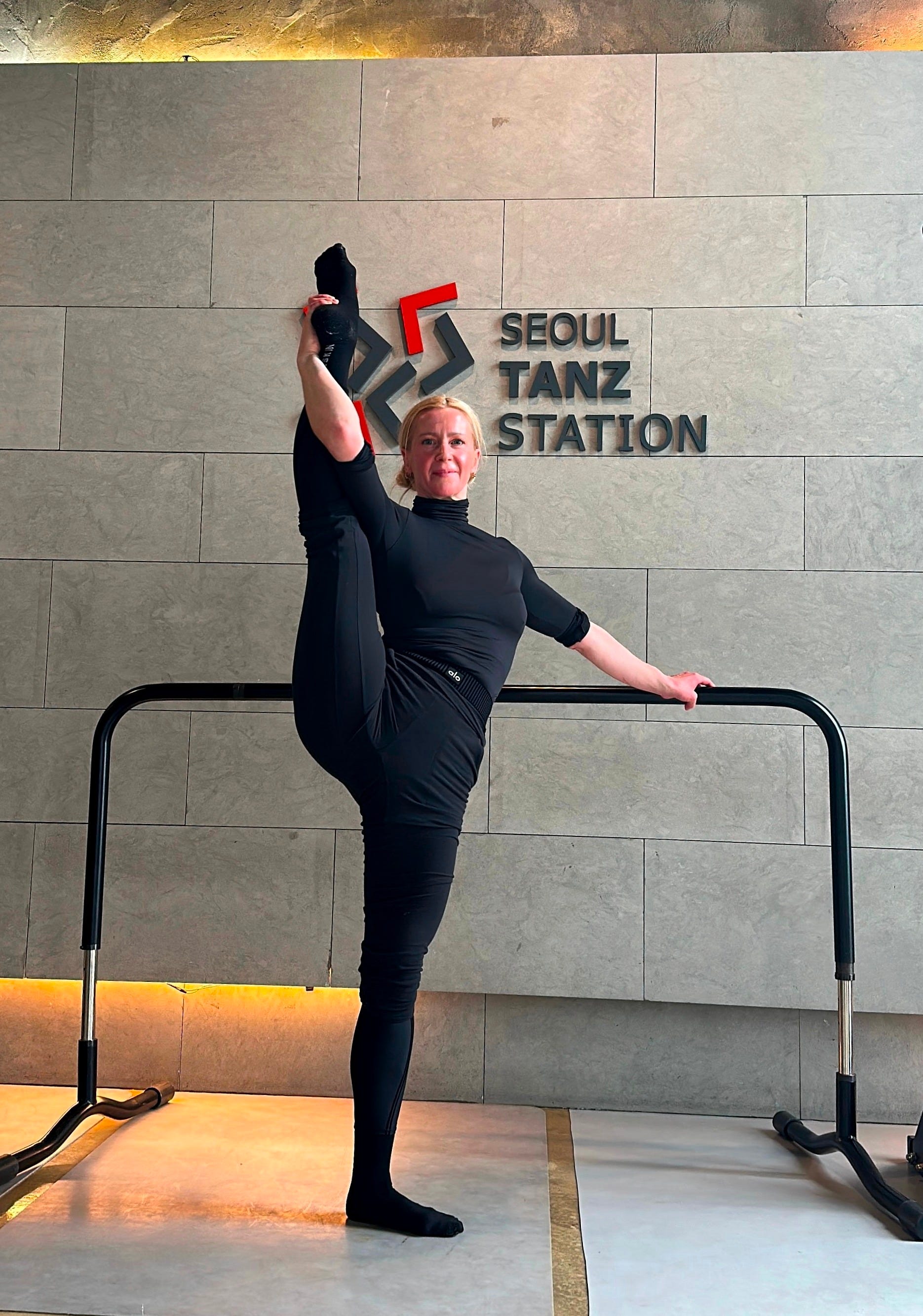
The classes were taught in Korean, but between demonstration, French terminology, the predictable structure of a ballet class, and a sense of the corrections typically being examined, I was able to follow without much difficulty. Despite the active stretching that I saw at the fitness centre, a large set of the dancers in class were warming up by sitting passively in stretches. Passive stretching may not be current best practice, but sitting in splits before class seems well entrenched in tradition and shows no signs of letting up.
What I appreciated was the age range in class. One day I counted and I was one of six people in their 40s or older training alongside younger professionals in between contracts, teachers, and enthusiasts. Late teens through early 70s, all dancing together. It's something I've encountered in the best classes elsewhere over the past year, notably at Harbour Dance in Vancouver, Pineapple in London, and The School of Dance in Ottawa. I hope to be one of the elders one day.
Underground and Up
Outside of formal training, I walked. A lot. I moved through the historic lanes of Bukchon Hanok Village and across the grounds of Gyeongbokgung Palace; past the National Museum of Modern and Contemporary Art, where a remaining installation from the Seoul Biennale of Architecture and Urbanism, the “Wall of Humanism”, stood as part of the city’s ongoing examination of density, housing, infrastructure, and public space. I continued through the university energy around Dongdaemun; through the former shoe factories and warehouse buildings of Seongsu, now converted into cafés and brand pop-ups ranging from local retailers like Musinsa to international names like Adidas; an evening spent at Gwangjang Market; and through Myeongdong’s dense shopping areas, vibrant night markets, cosmetics counters on every corner, and everything in between.


Walking in Seoul meant moving not only across neighbourhoods but up and down through them. At Lotte Department Store, the upper floors held luxury brands—Rolex, Louis Vuitton, Chanel, Prada—attached directly to a hotel and Michelin-listed restaurants. Just above the underground level sat the food hall, immaculate and expansive, easily rivaling Harrods in scale and presentation. Below that, corridors extended outward, lined with smaller shops and kiosks, many no larger than 100 to 150 square feet. Most appeared independently operated, each specializing narrowly, accessories, prayer beads, phone cases, budget clothing, arranged in long, fluorescent-lit passages connected directly to subway entrances. You move from Yves Saint Laurent to strawberries to subway in minutes.
With the underground network, I could walk from the basement of my hotel to Lotte, passing hundreds of shops below street level, roughly half a kilometre without ever going outside. Being February, temperatures ranged -6 to -3 C. While considerably milder than the -20 C I left behind in Ottawa, I welcomed walking underground when I needed a break from the cold.
Eating the City
I’ve always liked Korean food, having had my fair share of it living in Vancouver, being particularly fond of banchan, the fermented side dishes that accompany everything else. In Seoul I ate well and often: bibimbap (mixed rice bowl), kimbap (seaweed-wrapped rice rolls with various fillings), bulgogi (marinated beef), pajeon (savoury scallion pancake), sundubu jjigae (soft tofu stew), hobakjuk (pumpkin soup), kalguksu (knife-cut noodles), seaweed in soup, snack, and fermented varieties, wang mandu (steamed king-sized dumplings), and yubu chobap (seasoned rice and various fillings stuffed into sweet tofu pockets). I was happy to find steamed greens each morning at breakfast, kimchi with nearly every meal, and quick bites from market stalls or between subway stops.


Food Halls
The food halls were the real event for me. I spent several lunches there and always found something new. Noodle stations pulling hand-cut strands to order. Sushi boats offering otoro with truffle, sea urchin wrapped in gamtae, an edible seaweed that has been gaining attention in Korean kitchens for its softer texture and oceanic flavour, and which chefs are increasingly featuring on menus both in Korea and abroad. Temporary pop-ups selling unusual hybrids: sweet rose pasta at one stall, Korean-style corn dogs at another. Italian beside Korean beside Singaporean beside something vaguely Californian. The stalls were immaculately clean, even with open kitchens, and their products beautifully presented. I often did a couple of laps before deciding what to eat, grateful to be alone and not inflicting my decision paralysis on anyone else.
Cafés
Regardless of what novelties there were, I am a sucker for coffee and a sweet something particularly in the afternoon. Seoul has a serious coffee culture, and European pastry techniques are clearly part of the landscape. Many Korean pastry chefs train in France, and there’s even a Le Cordon Bleu campus in Seoul, but what appears in the display cases suggests a standard in which technique supports substance as much as presentation, even at scale. If I weren’t so wary of looking like an overzealous tourist, I would have photographed every display.


I had one of the better canelés I’ve tasted at Patisserie Mur in the Starfield COEX food hall. Canelés have been trending for years, but they are often, in my experience, poorly executed. Traditionally baked in copper molds coated with beeswax, they should have a dark, caramelized crust and a custard-like centre, not the uniformly hard texture of a small pound cake. I’m more of a cook than a baker, but I appreciate the technical precision and consistency required to execute pastry well.
I was directed toward their salt bread, and it was soft, buttery, properly salted. Originally from Japan, it has been widely adopted in Korea, where bakeries tend to enrich it further. One version I tried was filled with Dubai chocolate, a pistachio-based confection that is very much on trend, wrapped in a soft, salty bun. The server suggested the melon bread as well. It carried a clear green melon note and, despite its appearance, wasn’t soda sweet. I can manage only a few bites of something sugar saturated before it becomes too much and this stayed well below that threshold.
Gift Culture
Gift culture in Korea is striking in its practicality, a logic that becomes clearer when you begin with how items like Spam entered Korean kitchens after the Korean War before expanding into today’s premium fruit and seafood gift sets. Alongside beautifully boxed fruit—perfectly graded apples or pears that signal care, seasonality, and status—you’ll find meticulously packaged Spam sets and premium seafood gift boxes stacked for holidays like Chuseok (the autumn harvest festival) and Seollal (Lunar New Year), which was about a week away when I was there. High-end department stores prominently display sets of dried yellow corvina, abalone, premium tuna, or carefully portioned beef and fish, arranged in lacquered or insulated boxes. Seafood gifting is tied to status and seasonality: it signals abundance, freshness, and the ability to offer something both luxurious and immediately useful for family gatherings.


Spam’s presence traces back to the Korean War (1950–1953), when food shortages were severe and U.S. military rations, including canned meats, entered local circulation near American bases. What began as survival protein during wartime scarcity was gradually absorbed into Korean cooking—most famously in budae jjigae, or “army stew”—and later reframed as a useful, even premium, gift. Koreans tend to value gifts that are practical and consumable. Spam is usable. High-quality fruit, especially when perfectly ripened and beautifully boxed, is both perishable and precious, something to be shared and enjoyed at its peak.
Temple Food
What I didn’t get to, but would have loved to experience, was temple food. Korean temple cuisine has been gaining serious international attention and is currently under review for designation as a UNESCO Intangible Cultural Heritage. I remember first encountering it years ago through Avec Eric, when Éric Ripert profiled it in his travel series after studying with Venerable Jeong Kwan—the Buddhist nun who later appeared on Chef’s Table—and spoke about how the experience shaped his philosophy around food. Temple food follows Buddhist principles: plant-based, free from garlic and onions, deeply rooted in fermentation, and guided by seasonality and restraint. It is less about performance and more about clarity. If I’d had more time, especially time to leave the city and visit one of the temples, I would have arranged it. Next trip.
Glass Skin
The woman I’d met at the sushi bar had also insisted on calling ahead to secure the best masseuse at the hotel spa for a lower leg treatment. I’m not typically drawn to spa services, but a week of walking and dancing made a convincing argument. The treatment was rough, in a good way. I could barely walk the next morning, which I think is a sign of a quality service. It was consistent with what I had begun to notice: at least in the spaces I was moving through, care felt less like indulgence and more like something built into daily life.
We’ve all heard about Korean skincare, but being there made me want to understand what actually drives it. Reading further led me to a Vogue Business piece describing a system that moves faster than many other markets, with fewer regulatory barriers around certain procedures and ingredients. Polynucleotide injections derived from salmon DNA, exosome therapies, and stem cell–adjacent technologies are more visible and accessible in South Korean clinics, where treatments are layered and refined quickly, often in collaboration with dermatologists and biotech firms. In other major beauty markets, including the United States and France, brands have tended to lean toward non-animal-derived alternatives; when snail mucin surged, many reformulated or promoted plant-based substitutes to meet consumer expectations and regulatory climates. In South Korea, the emphasis is regenerative and preventative rather than corrective. Barrier health, collagen stimulation, and ongoing maintenance are standard practice, not experimental add-ons. “Glass skin,” luminous and hydrated, reads less as a fleeting trend and more as the visible outcome of that maintenance-driven philosophy. The density of clinics, counters, and specialised spas made clear this was not fringe culture but, as with food and fitness, an integrated part of urban life.
Transit
On the way there, the flight was delayed so I made the choice to head to the yoga room at YVR rather than take a seat at the bar or café and accelerate my dehydration. I worked through sun salutes, handstands, side planks, and standing postures, attempting to stave off the stiffness from the 11-hour flight to come. It helped. I slept for two hours on the flight to Seoul, which for me is a triumph. I was late arriving to the airport on the journey back, but I did have enough time for a gym session in the morning. I have found it a challenge to adjust back into the local timezone from being in that part of the world before and this time was no exception.
Despite the inconveniences, jet lag, travel delays, language barriers that made an ATM nearly impossible without Google Lens, and one regrettable oyster, travel for me is always worth it. Somewhere between transfers, I noticed a subway poster quoting children’s author Kang Mi-Jeong: “Three things you cannot get back: the time that has passed, the lost opportunity, the spoken word.” Wisdom in the subway. A reminder, perhaps, not to waste days or words.
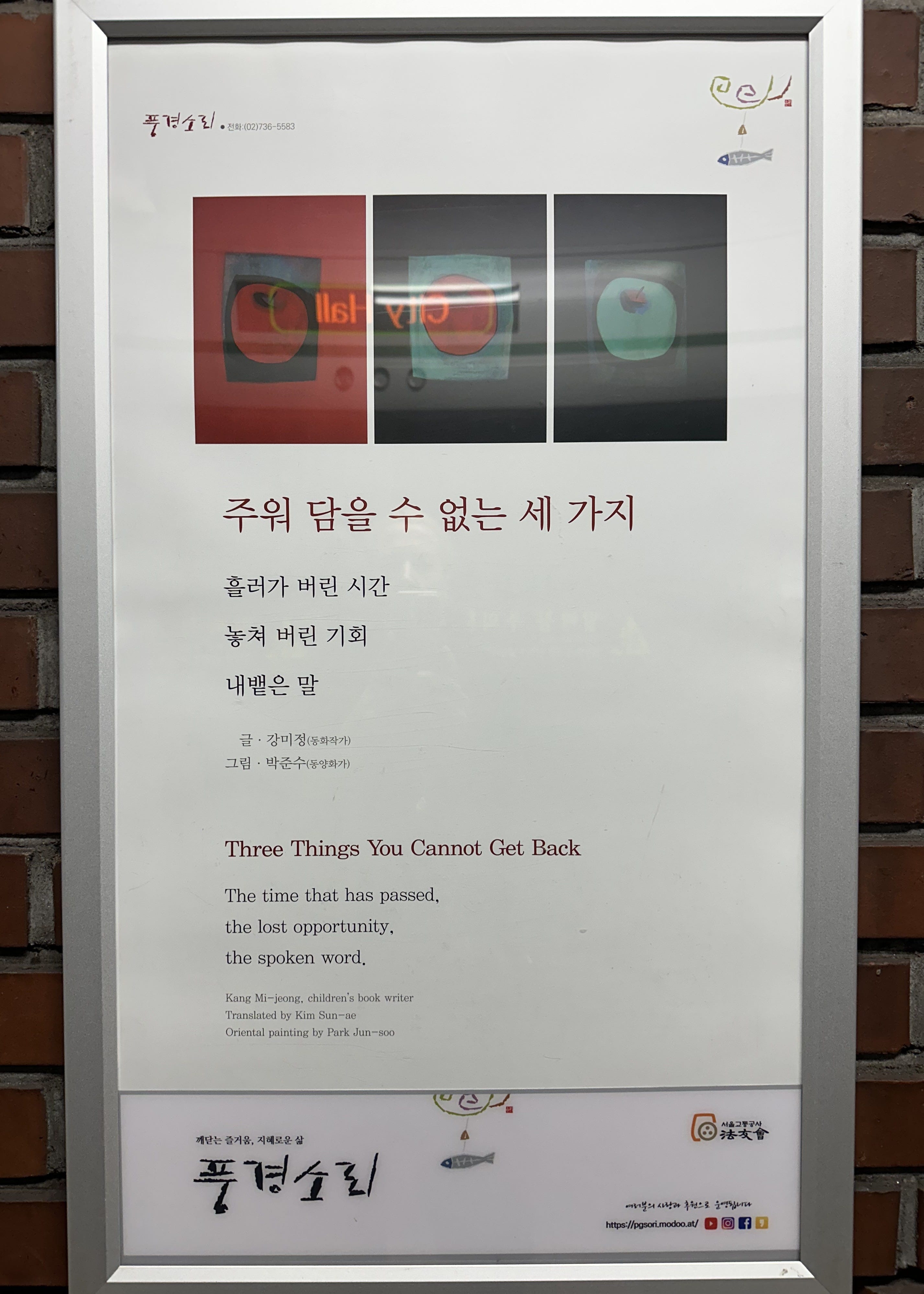
There is always a shift in perspective from being in other places that seems to colour what’s next for me in life and, for whatever reason, I felt it more acutely in Seoul. What am I coming away with? Perhaps self-care is simply part of a day well lived. Perhaps I left opportunity on the shelf after all. In a city awash in well-priced socks, was five pairs too conservative? I have certainly learned, after already casting off the live variety years ago, that there will be no more oysters in my life. The struggle now is not to let any of these insights, or loftier ones, dissolve like most New Year's resolutions. Apparently my sign is to be the luckiest in the Year of the Horse. I intend to test that.
Further Reading
Static stretching is not warming up: The Dancer's Ultimate Guide to Stretching
Vogue: Inside the Most Advanced Beauty Industry in the World